
Ways to Have a Shoplifting Case Dismissed in New Jersey
Shoplifting Charge Dismissal and Reduction Options in NJ

The good news is that shoplifting charges can often be dismissed or reduced when the case is defended properly. An experienced criminal defense attorney does far more than stand next to a client and ask for leniency. The defense starts with a hard look at how the case was built. Was the stop lawful? Did store security follow the rules? Was the accusation based on actual proof or on assumptions and pressure tactics?
Surveillance video, witness statements, and the handling of the merchandise all matter. Many cases fall apart once those details are challenged. Others resolve through diversionary programs, negotiated reductions, or motions that keep illegally obtained evidence out of court. The outcome depends on strategy, timing, and how quickly the defense gets involved.
The penalties for a shoplifting conviction can be severe. Jail time is possible, even for a first offense. Courts can impose fines and order restitution to the store. Community service is common and often interferes with work and family obligations. The criminal record itself may be the most damaging consequence. A theft conviction can follow someone for years and close doors to jobs, housing, professional licenses, and school programs. Non-citizens face immigration problems, including the possibility of removal proceedings or the loss of future immigration opportunities.
Early involvement by a criminal defense attorney can protect the client’s rights. Preservation of favorable evidence and building a defense at the beginning of a case puts the defendant in a more favorable position. With the right strategy, many shoplifting cases can be resolved in a way that avoids life-altering consequences and gives the client a real chance to move forward.
What Must Be Proven to Convict Someone of Shoplifting in New Jersey?
Intent is an extremely important component of shoplifting cases, as it involves the desired outcome of the defendant as he or she commits an act. This is known as the “mens rea” or criminal intent. In order for the shoplifting charge to hold up in court, the prosecutor has to prove beyond a reasonable doubt that you committed an act of shoplifting with the intention of depriving the store of the merchandise without paying for it, or without paying the full value.
For example, if you “accidentally” walked out the door without paying for something, your intention was not necessarily to steal it. If you paid for a shopping cart full of items but neglected one single item in your pocket or underneath your shopping cart, you are obviously going to have a much better case than if you grabbed a pile of DVDs and walked out the door.
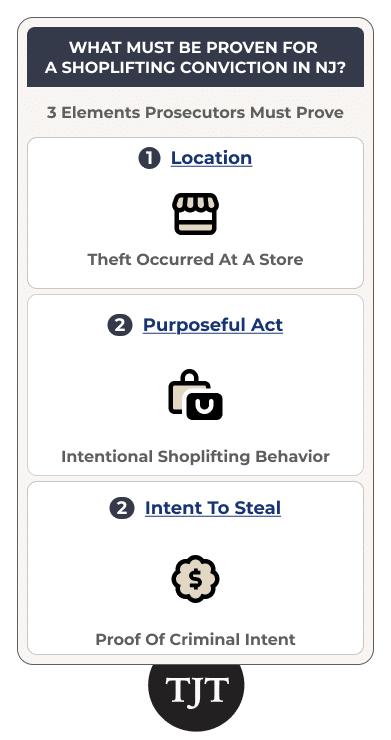
The first element is that a theft happened at a store, meaning it applies only to conduct that occurs on retail premises. That includes the inside of the store, the parking lot, and common areas of a mall that are connected to the retail business. The defense team works to establish whether the location meets the requirements that the statute establishes.
The second vital element requires someone to perform a purposeful act of shoplifting. The following actions qualify as specific behaviors, which include taking merchandise from displays and hiding it, changing or swapping price labels, moving items between containers, performing under-ringing at checkout, and taking shopping carts without authorization. The conduct must be purposeful. The State needs to prove that the person performed their actions on purpose. A person who shops while distracted, together with incorrect prices at checkout and quick payment processes, might create doubts, but these circumstances do not establish evidence of wrongdoing. The court should maintain its dismissal of charges because there exists no proof that demonstrates the defendant intentionally took any action.
The third essential factor for this case is intent to steal. The law enables the State to use a legal presumption that demonstrates that hiding merchandise indicates someone plans to steal. The assumption maintains strong validity, but it does not create an impossible barrier to overcome. The defense team will fight against this evidence through proof of alternative explanations, faulty witness observations, and missing evidence from the store. The case will end in failure when the State fails to prove intent beyond a reasonable doubt after they successfully rebut the presumption.
Where Will My Shoplifting Case Be Heard in New Jersey?
Where a shoplifting case is handled depends largely on the value of the merchandise involved. The case progression depends on the two court systems that New Jersey operates. The potential penalties and how the case is defended also differ.
The charge is treated as a disorderly persons offense when the value of the merchandise is less than $200. The case is heard in Municipal Court, where it is decided by a judge, not a jury. There is no grand jury, no indictment, and no jury trial. The process follows official procedures, while evidence rules apply to all cases, which result in potential severe penalties. A conviction creates a criminal record, and jail time becomes a possible outcome.
When the merchandise is valued at $200 or more, the charge becomes an indictable offence, and the case is handled in the Superior Court, Criminal Division. These cases move through the grand jury process and are ultimately tried before a jury unless they are resolved earlier. The penalties increase with the value of the merchandise, and so does the exposure to prison time and long-term consequences. Defense strategy becomes even more critical at this level, since mistakes early in the case can make an acquittal more challenging.
Shoplifting cases involving juveniles are heard in the Family Division of the Superior Court. The focus is still on accountability, but the procedures and outcomes focus on rehabilitation rather than punishment.
The Two Types of Courts That Handle Shoplifting Charges in New Jersey
Many shoplifting cases are won by attacking the prosecution’s evidence. Dismissals happen when the defense exposes the weaknesses in how the case was built and forces the State to prove every required element beyond a reasonable doubt. When that proof falls apart, the charge should fall with it.
One of the most common pressure points is witness testimony. Store employees and loss prevention officers are often the backbone of the prosecution’s case. Their observations are what connect the defendant to the alleged conduct. Those witnesses must appear in court and be available for cross-examination. In many situations, a failure to appear can lead to a dismissal. At a minimum, it can force a postponement that gives the defense additional leverage. When witnesses do testify, their credibility, training, vantage point, and consistency all become fair game to be challenged.
Video surveillance is another area where cases frequently unravel. In modern retail stores, cameras are everywhere. Judges expect to see video when shoplifting is alleged. When the State cannot produce footage, the case often rests entirely on subjective recollections. Memory fades. Details change. Two people can describe the same moment very differently. Without a video to back it up, that type of testimony may not be enough to prove a purposeful act and intent to steal beyond a reasonable doubt.
When building a defense strategy, experienced attorneys thoroughly examine multiple factors, including:
- Whether you actually left the store premises
- Whether you paid for some items but not others
- Whether there is any evidence that you removed price tags
- Whether video evidence exists and what it shows
- Whether there are witnesses to the alleged theft
- Your prior criminal history
Self-checkout technology creates its own set of problems for prosecutors. Registers can malfunction, and items may disappear from the screen. Broken scanners and software glitches can turn an honest transaction into an accusation. When the defense shows that the equipment was unreliable, reasonable doubt follows. A case that looks simple on paper can become very complicated once the technology is examined closely.
Intent is often the hardest element for the State to prove. The law allows prosecutors to rely on a presumption of intent when merchandise is concealed, but that presumption can be challenged. Accidental exits, confusion at checkout, or honest mistakes can defeat the charge when supported by the evidence. Someone who paid for most of their items and forgot a single product at the bottom of the cart presents a very different picture than a person who deliberately tried to steal.
Procedural failures can also end a case. Prosecutors are required to provide discovery, including reports, videos, witness lists, and other evidence, within strict time limits. When the State does not comply, the defense can move to suppress evidence or seek dismissal. Everyone has the right to a speedy trial. When deadlines are missed, it is often the defense that benefits.
The Role of Circumstantial Evidence
Successfully combating shoplifting charges often involves challenging the circumstances of your arrest. The circumstances in your case play a significant role in determining the strength of the prosecution’s case. At The Tormey Law Firm, our NJ shoplifting defense attorneys thoroughly examine the circumstances of your case, including police reports, surveillance video, witness statements, and everything included in the discovery report, in order to identify any potential weaknesses in the State’s case. We then build a strategy to exploit these weaknesses in court and work to have the charges downgraded or dismissed altogether.
Should I Accept a Plea Deal for Shoplifting Charges?
In some situations, resolving the case through a negotiated plea can reduce the damage and bring the matter to a close more quickly. A defendant who pleads guilty does not need to prove that the state has a solid case against them. The decision to plead guilty emerges as a strategic choice that defense attorneys make after they assess all evidence, trial dangers, and future objectives of their clients.
The negotiation process between lawyers results in either reduced criminal charges or less harsh penalties. A case that started as an indictable offense may be amended to a disorderly persons offense. The program lets participants stay out of jail. The court system allows defendants to obtain better terms for their fines, community service, and probation requirements. A plea agreement becomes effective for expungement eligibility when the court accepts it in appropriate situations.
Pleading guilty is not the right choice for everyone. Some cases should be fought. Others should be dismissed. The decision depends on the strength of the evidence, the person’s record, immigration concerns, and possible repercussions. An experienced criminal defense attorney helps their client to evaluate all available choices before selecting the most suitable option.
Understanding Plea Agreements for Shoplifting Cases in New Jersey
The best outcome for shoplifting defendants would be to stay out of court while avoiding any need to admit their guilt. It is a dismissal through a diversionary program. New Jersey provides defendants who meet eligibility requirements with the opportunity to finish their supervision period and obtain dismissal of their case, which prevents them from getting a theft conviction on their record.

Conditional Dismissal is the municipal court version of diversion. It is available for disorderly persons shoplifting cases when the defendant meets specific eligibility requirements. Like PTI, the case is paused while the defendant completes court ordered conditions. Successful completion results in dismissal. For many first-time offenders, Conditional Dismissal is the path that keeps a single mistake from becoming a lifelong problem.
Diversionary programs are powerful tools. They protect a person’s future by keeping a criminal conviction off their record. The key is knowing how to present the case so the court and prosecutor are willing to say yes.
Frequently Asked Questions About Shoplifting Charges in New Jersey
Can shoplifting charges be dismissed in New Jersey?
Yes, shoplifting charges can be dismissed in New Jersey with the right defense strategy. Common grounds for dismissal include lack of evidence, missing witnesses, no proof of intent, procedural violations, or participation in diversionary programs like PTI or Conditional Dismissal.
What happens if I’m a first-time offender?
First-time offenders may qualify for Pre-Trial Intervention (PTI) for indictable offenses or Conditional Dismissal for disorderly persons offenses. Successful completion of these programs results in case dismissal and no permanent criminal record.
Is shoplifting a felony in NJ?
Shoplifting becomes an indictable offense (similar to a felony) when merchandise is valued at $200 or more. Items under $200 are charged as disorderly persons offenses handled in municipal court.
What if I forgot to pay for an item?
If you accidentally forgot to pay, you can defend against shoplifting charges by proving a lack of intent to steal. This is especially viable if you paid for other items and can demonstrate the oversight was unintentional.
Can a shoplifting conviction affect my immigration status?
Yes, shoplifting convictions can have serious immigration consequences for non-citizens, including deportation, denial of naturalization, or inadmissibility. It’s critical to fight these charges with an experienced attorney.
What if there’s no video evidence?
Without video surveillance, the prosecution must rely solely on witness testimony, which is more subjective and easier to challenge. This significantly weakens their case and may lead to dismissal.
How long do shoplifting cases take in NJ?
Case duration varies by court type and complexity. Municipal court cases typically resolve faster, while superior court indictable offenses may take several months depending on discovery, motions, and trial scheduling.
Contact an Experienced New Jersey Shoplifting Defense Attorney
Facing shoplifting charges in New Jersey is serious, but you have options. The attorneys at Tormey Law Firm have extensive experience defending clients against theft charges and fighting for dismissals, diversionary programs, and reduced penalties. We know how to challenge the prosecution’s case and protect your future. From our convenient office locations in Bergen County, Morris County, Essex County, and Camden County, we assist clients across New Jersey in successfully resolving their shoplifting matters. We regularly appear in courts in Hackensack, Paramus, Rockaway, Paterson, Jersey City, and Morristown throughout the state.
Contact us today for a free consultation. Call (201) 556-1570 to speak with an experienced criminal defense attorney who will fight for the best possible outcome in your case.