
New Jersey Hollow Point Bullet Laws: Charges, Penalties & Defenses
How Legal Ammunition Becomes a Felony at the NJ Border
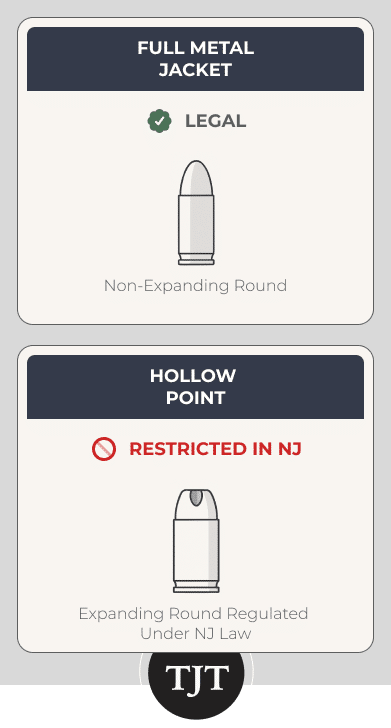
Hollow point bullets, sometimes called hollow nose bullets or dum-dums, are ammunition designed with a cavity in the tip or nose of the projectile. Unlike full metal jacket rounds, the front of the bullet is intentionally hollowed out rather than smooth or pointed. This characteristic allows the bullet to expand when it strikes a target.
People choose hollow-point ammunition for several practical reasons. In self-defense contexts, the expansion is intended to stop a threat more quickly. For hunting, expanding bullets are commonly viewed as more humane because they reduce the likelihood of a long, wounding injury. Many users also believe hollow points are safer in populated areas because they are less likely to pass through a target and strike someone else.
Hollow-point ammunition is not rare or exotic. It is manufactured in many of the most common handgun calibers sold today, including 9mm, .45 ACP, and .40 S&W. Expanding designs also exist for certain types of rifle ammunition. In most parts of the country, these rounds are sold over the counter and treated as ordinary ammunition. In New Jersey, that assumption can lead to serious criminal charges.
Our New Jersey criminal defense lawyers regularly represent clients charged under the state’s ammunition and firearms statutes, including cases involving hollow-point ammunition under N.J.S.A. 2C:39-3(f). We see how quickly a routine stop can turn into a serious weapons prosecution, especially for out-of-state visitors who had no idea New Jersey treats their carry or range setup as a crime.
New Jersey Hollow Point Ammunition Laws Under N.J.S.A. 2C:39-3(f)
New Jersey’s hollow point law is grounded in N.J.S.A. 2C:39-3(f). Under the law, any person who knowingly possesses hollow-point ammunition outside an authorized exemption commits a fourth-degree crime. The statute does not require proof that the person intended to use the ammunition unlawfully or harm anyone. Possession alone is enough to trigger criminal liability.
This area of the law functions close to strict liability. Prosecutors do not need to show criminal purpose. They only need to establish that the defendant knowingly possessed the ammunition and that no exemption applied at the time of possession. As a result, many cases involve individuals who were not engaged in criminal activity of any kind.
Each round of hollow-point ammunition can be charged as a separate count. A person stopped with a loaded magazine or a box of ammunition may face dozens of identical charges arising from a single traffic stop. While some cases are ultimately resolved through consolidation or negotiation, the charging exposure at the outset is real and significant.
A legal purchase in another state is not a defense. New Jersey law applies the moment a person enters the state. Ammunition that is freely sold and lawfully owned elsewhere becomes criminal possession here unless it fits squarely within a New Jersey exemption.
Likewise, claiming ignorance of New Jersey law does not help. Courts do not excuse possession because a driver was unaware of the statute. Lawful ownership in a home state and a lack of criminal intent do not prevent arrest or prosecution. Simply traveling through New Jersey with hollow-point ammunition can be enough to trigger charges. Passing through the state on vacation, stopping for gas, or staying overnight does not create a safe harbor under the statute.
Anyone entering New Jersey should carefully check vehicles, luggage, range bags, purses, and backpacks before crossing the border. Many hollow-point arrests begin with a few forgotten rounds in a glove box or a bag that has not been emptied since the last trip to the shooting range.
Who Can Legally Possess Hollow Point Bullets in NJ
Authorized Personnel
New Jersey law recognizes a limited group of people who may lawfully possess hollow-point ammunition outside the general public, and only under defined conditions. Law enforcement officers may possess hollow-point ammunition while acting in the scope of their official duties. Members of the military and the New Jersey National Guard are also exempt when possession is connected to their official service or assignment. Licensed firearms collectors holding a valid federal Curios and Relics collector’s license may possess hollow point ammunition only when the rounds themselves qualify as curios or relics. Members of authorized rifle or pistol clubs may possess hollow-point ammunition in connection with club activities, but only if the club is formally approved. The statute requires the club to file an annual charter with the New Jersey State Police.
Authorized Locations and Purposes
For civilians, lawful possession of hollow-point ammunition is limited to specific places and tightly controlled movement between them. Possession may be lawful inside the home, at a fixed place of business owned by the person, or at an authorized firing range or hunting location. Outside those settings, the only protection offered by the statute is during direct travel between authorized locations.
Transport rules are strict. Ammunition must be properly secured, and travel must be uninterrupted and purposeful. Unnecessary stops, detours, or casual storage in a passenger compartment can take someone outside the exemption and expose them to criminal charges.
New Jersey also regulates how hollow-point ammunition can be acquired. Under N.J.S.A. 2C:58-3.3, purchases are restricted and tied to the state’s firearms permitting framework. The statute reflects the same policy choice seen throughout New Jersey’s weapons law: hollow-point ammunition is treated as inherently restricted, with possession allowed only when a clear statutory justification exists.
What Happens If You’re Caught With Hollow Points in NJ?
Is Hollow Point Possession a Felony in New Jersey?
Possession of hollow-point ammunition in violation of New Jersey law is not a minor offense. It is charged as a fourth-degree indictable crime under N.J.S.A. 2C:39-3(f). In New Jersey, an indictable offense is the equivalent of a felony in other states. Each individual hollow point round may be charged as a separate count. That means a single traffic stop can result in dozens of charges based solely on the number of bullets recovered. Because this is an indictable offense, cases are not handled in municipal court. They proceed in the New Jersey Superior Court, Criminal Division. Once charged, the defendant is facing the full weight of state-level prosecution. A conviction carries long-term consequences. Beyond potential jail time and fines, an indictable conviction results in a permanent felony record, mandatory forfeiture of firearms, and disqualification from future firearms permits and identification cards. For non-residents, it may also create complications in their home state.
Related Weapons Charges Often Filed Together
Hollow-point charges almost never appear by themselves. Once police find ammunition during a stop or a search, the case often expands. Prosecutors look at everything around it, and if a firearm is anywhere in the picture, more charges tend to follow. A person may suddenly be facing unlawful possession of a weapon, a second-degree offense, even when the gun was purchased legally elsewhere. If that gun meets New Jersey’s definition of an assault firearm, the stakes rise even higher because the law treats that as another second-degree crime.
People with prior disqualifying convictions face a different problem. They can be charged as certain persons not to possess weapons, which carries second- or third-degree exposure and removes any argument that the possession was otherwise lawful. Prosecutors handle that statute aggressively, and it often becomes the centerpiece of the case.
Sometimes, a weapon for an unlawful purpose charge is added as well. That offense is also second degree and usually relies on how the circumstances appear to the state rather than anything the person actually did. On top of that, transport issues can trigger separate fourth-degree counts. Storing a firearm the wrong way, straying from a direct travel route, or misunderstanding what qualifies as an exemption can all lead to additional charges, even when the firearm itself is legal in the owner’s home state.
Penalties for Hollow Point Ammunition in New Jersey
A conviction for possession of hollow-point ammunition under New Jersey law exposes a defendant to the full sentencing range assigned to a fourth-degree indictable offense. For incarceration, the statutory range runs from zero to eighteen months in New Jersey State Prison. The sentencing framework allows judges to impose any term within that range, based on how the court weighs aggravating and mitigating factors.
For first-time offenders, there is a presumption of non-incarceration. That presumption means the court should favor a sentence other than state prison unless aggravating factors substantially outweigh mitigation. It does not mean jail time is impossible, and it does not prevent a conviction from carrying felony consequences. Judges typically begin their analysis near the midpoint of the range, roughly nine months, and then adjust upward or downward.
Probation and Alternative Sentences
Many fourth-degree cases resolve without state prison, particularly for defendants with no prior criminal history. Courts may impose supervised probation for a period of one to five years. Probation often comes with conditions such as reporting requirements, weapons forfeiture, and compliance monitoring. Shorter custodial sentences may be served in the county jail rather than state prison when the court imposes a term at the lower end of the range.
Fines and Court Costs for Hollow Point Convictions
Sentencing for a fourth-degree weapons offense also includes significant financial consequences. Courts may impose a discretionary fine of up to ten thousand dollars. In addition, certain assessments are mandatory under New Jersey law. These include a $50 assessment for the Victims of Crime Compensation Board, a $75 payment to the Safe Neighborhoods Services Fund, and a $30 contribution to the Law Enforcement Officers Training and Equipment Fund. These penalties apply regardless of whether the defendant receives jail time or probation. There are also additional costs for program-related costs, fines, and restitution, all of which add up.
How Judges Determine Sentencing in NJ Hollow Point Cases (N.J.S.A. 2C:44-1)
Aggravating Factors
Aggravating factors can push a sentence higher and may override the usual presumption against prison for a first-time offender. One of the first things a judge looks at is whether the person seems likely to reoffend, especially if the facts show a casual approach to firearms or ammunition rules.A prior record also carries a lot of weight. Judges don’t just note that a conviction exists; they look at how many there are, how serious they were, and whether they resemble the current charge in any way. The court also pays close attention to the details of the incident itself. Where the ammunition was found, how it was stored, and whether it was easy to reach often shape the judge’s view of the situation. Suppose the conduct caused or even suggested the possibility of serious harm, which can count as an aggravating factor, even when no one was actually hurt. Perceived risk can matter as much as actual injury. A defendant’s broader criminal history, including old arrests and prior convictions, ties all of this together. It often becomes a key part of the sentencing decision and heavily influences how much leniency the court is willing to extend.
Mitigating Factors
Mitigating factors work in the opposite direction, giving the judge reasons to reduce a sentence or avoid incarceration altogether. One of the strongest points in a defendant’s favor is a clean record. For someone with no prior involvement in the criminal system, that history—or lack of one—often carries real weight. Courts also look at whether the conduct actually caused harm or realistically could have. In many hollow-point cases, the possession is passive, and nothing about the situation suggests danger. That can help soften the court’s view of the offense. A judge will also consider whether the person is likely to reoffend. Steady work, family responsibilities, and a lifetime of staying out of trouble all contribute to the sense that the incident is isolated rather than a pattern. Cooperation during the investigation can help as well. Simple things like answering basic questions, complying with directions, or generally making the process easier—without giving up legal rights—can be viewed as a positive factor. Another issue is whether jail time would create an unusual hardship, either for the defendant or for dependents. Courts do not grant this lightly, but when the impact is clear, it can influence the outcome. Finally, judges look at the person standing in front of them. Character, attitude, and an honest misunderstanding of New Jersey’s laws often paint a fuller picture and support the conclusion that another offense is unlikely.
Long-Term Consequences of a Hollow Point Conviction
A conviction for possessing hollow-point ammunition carries consequences that reach far beyond whatever sentence the judge imposes. In many cases, these aftereffects end up causing more lasting harm than a short jail term or a period of probation.
An indictable conviction creates a felony record that does not quietly fade. It isn’t treated like a minor offense that clears after a few years. Once it exists, it stays with the person for life unless and until they qualify for a later expungement, and that process is neither automatic nor quick. Background checks pick it up, and it often shapes how others view the individual long after the case closes.
The conviction also triggers a complete loss of the right to own or possess firearms in New Jersey. Any permits or identification cards are forfeited, and the individual is permanently barred from possessing guns or ammunition under state law. In some cases, the state conviction also creates a separate prohibition under federal law, which can complicate matters even further.
Employment and licensing issues are common. Most employers run background checks, and a felony can affect hiring decisions, promotions, or continued employment. Licensed professionals—teachers, nurses, security personnel, and others in regulated fields—may face disciplinary reviews, suspension, or the loss of their credentials. Even lenders and landlords sometimes treat a criminal record as a sign of elevated risk.
For non-citizens, the consequences can be even more severe. A weapons-related conviction can trigger immigration problems, such as inadmissibility, removal proceedings, or denial of naturalization. These outcomes can arise even for long-term lawful residents who have spent decades in the United States.
Can You Get PTI for Hollow Point Charges in New Jersey?
Pre-Trial Intervention, commonly called PTI, is often the most important option for first-time offenders charged with hollow point ammunition offenses. PTI is a diversionary program designed to provide supervision and rehabilitation rather than punishment.
PTI operates as a form of supervised probation, typically lasting between twelve and thirty-six months. During that period, the defendant must comply with court-ordered conditions, which may include reporting requirements, fines, forfeiture of weapons, and continued law-abiding behavior. If the defendant successfully completes the program, the criminal charges are dismissed. There is no conviction and no criminal record stemming from the case. For many defendants, PTI is the only way to avoid the permanent consequences of a felony weapons conviction.
What Happens If PTI Is Denied for Hollow Point Charges in NJ?
Admission into PTI requires prosecutorial consent. When a prosecutor denies PTI, the defendant is not without recourse. The decision may be appealed to a judge in the Superior Court. The defendant must show that the prosecutor’s decision was clearly unreasonable, arbitrary, or based on improper considerations. Judges consider the defendant’s motivation, age, background, and overall character. They also consider the specificities of the charges and their circumstances.
Conditional Dismissal as an Alternative
Conditional dismissal is another diversionary option, though it is only available if your charges are downgraded to Municipal Court as disorderly persons offenses (misdemeanors). Every now and then, depending on the person’s history and the exact circumstances of the charge, it may still be considered.
The structure is similar to PTI in that the defendant can avoid a conviction by meeting certain court-ordered conditions for a set period of time. The difference is that the level of supervision is usually lighter and the program tends to run for a shorter duration. It is not a common solution in hollow point prosecutions, but in the right situation, it can still serve as an alternative path out of the criminal system.
Can You Drive Through NJ With Hollow Points? What the Law Actually Says
Rules for NJ Residents
Transporting Hollow Points to the Range or Hunting
Hollow-point ammunition may be possessed while traveling directly to and from a lawful hunting location or firing range. Travel must be purposeful and uninterrupted. Ammunition should be transported in a locked container placed in the trunk. It helps to have paperwork readily available. A range card, hunting license, or something showing where you’re going can make it easier to explain the purpose of the trip if an officer asks.
Rules for Out-of-State Gun Owners Traveling Through NJ
Travel should follow the most direct route possible. Stops should be limited to true necessities such as fuel or emergencies. Both the firearm and the ammunition need to be locked up in containers and stored in the trunk, not within reach of the passenger area. It’s also smart to keep any paperwork handy, such as permits, range cards, or something showing where you’re headed—because New Jersey treats these transport exceptions very narrowly. Even small detours or unclear explanations can cause problems.
Frequently Asked Questions (FAQ) Regarding Hollow Point Bullets in NJ
Are hollow point/hollow nose bullets illegal in New Jersey?
Yes.
Are these felony charges?
Yes, it is a 4th degree indictable crime which is a felony charge in NJ.
Am I facing jail time?
Yes, up to 18 months in state prison if convicted of a 4th degree crime.
Does it matter that hollow points are legal in my home state where I bought them?
No, they are illegal to possess in New Jersey.
The First Few Weeks of Your Case Matter Most – Get Help With Your Hollow Point Case
The consequences of a conviction are too serious to face without someone who knows this area of law well. Getting an attorney involved early makes a real difference. The first few weeks of a case often determine what options remain on the table later, especially when it comes to PTI. Those applications move quickly, and they need to be supported with a clear showing of why the person deserves diversion. If deadlines are missed or the submission is thrown together without much thought, the chance to pursue PTI can disappear for good.
New Jersey’s hollow point statute is filled with narrow exceptions, technical definitions, and traps for the unwary. Firearms and ammunition cases demand detailed knowledge of New Jersey’s weapons law. These statutes are not intuitive and are enforced far more strictly than in most other states. Small factual details, such as the location of ammunition inside a vehicle or the stated purpose of travel, can determine whether possession is lawful or criminal.
Contact us today at (201)-556-1570 to speak with an experienced New Jersey weapons defense attorney about your hollow point case. We offer a free and confidential consultation to discuss your charges, PTI eligibility, and legal options.
Legally Reviewed By:
Travis J. Tormey, Esq.
Criminal Defense Attorney | New Jersey