
Attorney General Announces 14 Arrests in Organized Crime Gambling Case

At the center of the case is an alleged member of the Lucchese crime family, who the state claims financed the operation while his son handled day-to-day management. The wagers flowed through offshore betting sites and a loose network of local agents working across several states—a structure that kept the operation beyond the reach of rules governing licensed sportsbooks. The money trail drew attention quickly, with prosecutors estimating that nearly two million dollars moved through the network between 2022 and 2024.
College athletes allegedly played a role in sustaining the operation. The state claims they took wagers, passed along betting information, and helped expand the enterprise beyond New Jersey’s borders. That level of reach transformed what might have been a straightforward gambling case into something far more serious. By routing wagers through offshore sites and distributing them via local agents across multiple states, the group avoided the oversight that legal sportsbooks must follow.
The charges include racketeering, money laundering, conspiracy, and multiple gambling offenses. While legal sports betting exists in New Jersey, this prosecution demonstrates exactly what happens when betting activity falls outside the regulated framework.
How New Jersey Defines Legal vs. Illegal Gambling
New Jersey permits gambling only within a controlled system where casinos and licensed sportsbooks answer directly to the state, and racetracks follow stringent rules governing how betting is conducted. Most people don’t fully appreciate these distinctions until they find themselves in trouble.
Illegal gambling often appears innocuous at first—a private betting circle, an offshore site promising better odds, or a friend who offers to take wagers and settle up later. These situations feel low-risk until they aren’t. Once investigators get involved, they rarely focus on a single individual; anyone connected to money movement or record keeping can end up facing charges. Students, part-time bookies, and people who believed they were simply helping a friend often learn this lesson the hard way.
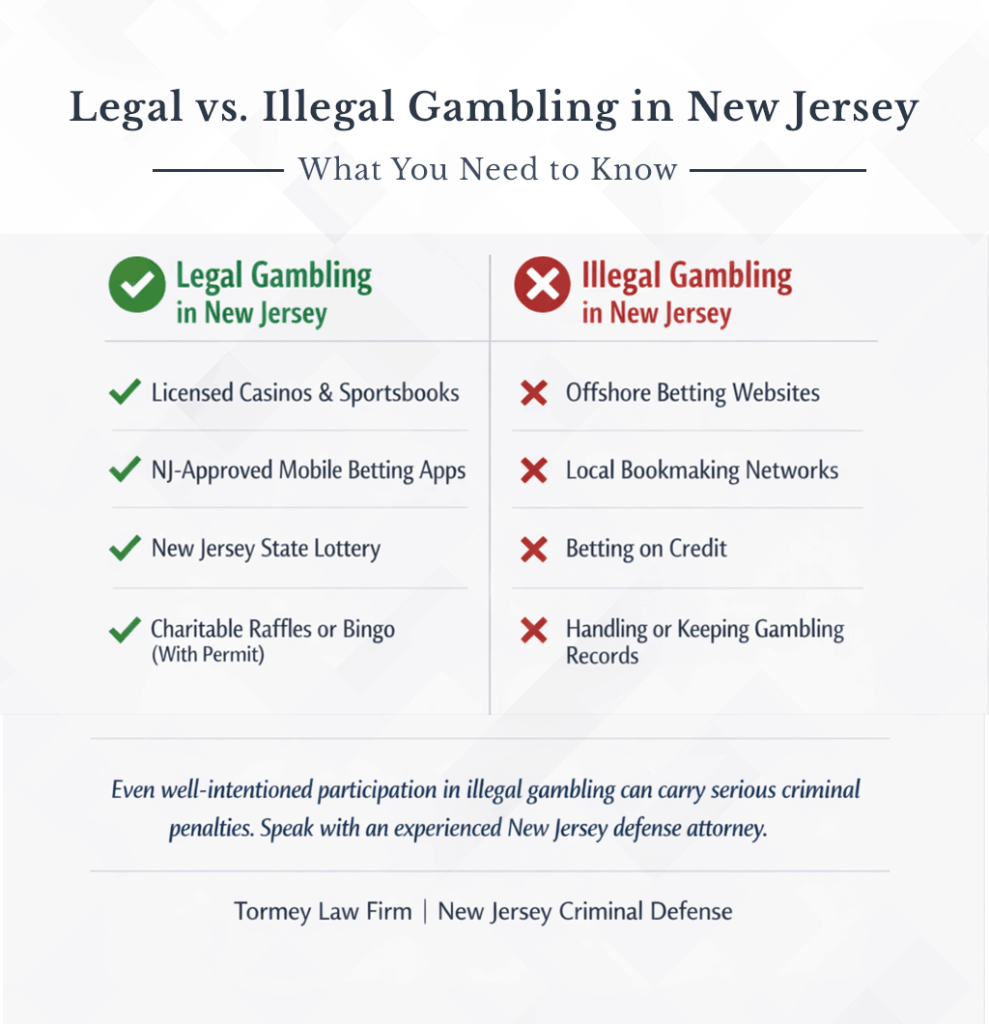
Which Types of Gambling Are Permitted in New Jersey?
Licensed casinos in Atlantic City remain the foundation of legal gambling in the state. Sports betting is permitted through approved casino partners and racetracks, both in person and through authorized mobile platforms, with all operators answering to regulators and following strict reporting requirements.
The state lottery remains a legal option, along with horse racing and simulcast wagering under state approval. Charitable games such as raffles or bingo can take place once the proper permits are issued.
Private poker games inside a home may fall within a narrow social gambling exception, but that protection disappears the moment someone runs the game for profit or begins handling money for others. This distinction matters far more than most people realize.
Types of Gambling That Lead to Criminal Charges
Offshore betting sites and local bookmaking operations are illegal regardless of whether they involve cash or credit. Taking bets on credit often signals a larger operation rather than casual betting, making it one of the first indicators investigators look for when building a case.
Private card rooms and backroom gambling spaces also attract scrutiny, and records play a crucial role in these investigations. Text messages used to make or take bets can support criminal charges, while payment logs or even a simple Excel spreadsheet listing wagers and payouts can provide valuable evidence. Once money starts moving through bank accounts or payment apps, prosecutors frequently add money laundering allegations to the case.
From Financier to Runner: How NJ Charges Gambling Participants
Promoting gambling charges vary in severity based on the scale of the operation and the defendant’s role within it. Those who finance an operation or supervise others face the highest exposure, and prosecutors trace money flow and communication patterns to support these claims. Even lower-level involvement carries serious consequences. Repeatedly taking wagers, acting as a runner, or helping manage betting activity can all lead to prison time. The informal nature of these arrangements offers no protection once records surface.
How Texts, Apps, and Spreadsheets Become Criminal Evidence
Possessing gambling records is itself a criminal offense, and modern technology has made record-keeping easier while simultaneously making seizure more straightforward for investigators. Phones, apps, screenshots, and spreadsheets can all qualify as gambling records if they document wagers or payouts. Many defendants first encounter this charge only after a device seizure, and a single phone search can fundamentally reshape an entire case.
How Do Prosecutors Prove Racketeering in Gambling Cases?
When prosecutors add racketeering charges, they frame a gambling case as an organized enterprise rather than a series of individual wagers. The focus shifts to patterns of behavior: repeated conduct, assigned roles, and steady money movement over time.
In gambling cases, the state typically relies on organizational charts and communication trails to establish the enterprise, with leadership positions and profit levels determining how far the charges extend. Once racketeering is alleged, asset seizure usually follows—cash and property tied to the alleged operation may be taken early in the proceedings. This pressure changes the legal landscape quickly and dramatically.
Money Laundering Allegations in Gambling Cases
Illegal gambling operations naturally lend themselves to money laundering charges because transfers between accounts, digital wallets, and cash pickups all become focal points for investigators. The charge centers on concealment, with prosecutors arguing that the manner in which funds moved was designed to hide their illegal source. Larger dollar amounts increase exposure significantly and raise the stakes for everyone involved.
How Do Prosecutors Use Conspiracy Charges in Gambling Cases?
Conspiracy charges allow the state to proceed even without proving that a crime was actually completed. Messages, brief exchanges, or shared tasks among individuals with aligned motives often form the foundation of these allegations. Most gambling cases include at least one conspiracy count because it gives prosecutors room to cast a wide net—even over people whose involvement was minimal.
What Are the Warning Signs of Illegal Gambling?
Several warning signs indicate potentially illegal gambling activity. Operations that allow betting on credit raise immediate concerns, as do offshore sites operating without proper licensing or age verification. Gambling activity run out of bars or private spaces often draws law enforcement scrutiny as well. Handling money or maintaining records for others remains one of the fastest ways to become entangled in a criminal case. This is precisely where many people find themselves pulled in far deeper than they ever intended.
Warning Signs You’re Being Recruited Into a Gambling Operation
Illegal operations constantly seek to expand their reach, and offers of quick money are common recruiting tactics. Requests to leverage personal networks typically follow soon after, with students and athletes being frequent targets because of their extensive connections.
Pressure to move money or track wagers represents another significant warning sign. Any mention of organized crime or implied threats should end the conversation immediately—these situations never improve with time.
How Can a Defense Attorney Help With Gambling Charges?

These investigations move quickly, with phone data, bank activity, and surveillance shaping the narrative early in the process. Waiting to respond almost always makes the situation worse. An attorney familiar with gambling cases understands where prosecutorial assumptions replace actual proof. That knowledge can limit exposure and fundamentally change the direction of a case.
How to Respond When Police Contact You About Gambling
Remaining silent is crucial because speaking without counsel can lock someone into statements that are difficult or impossible to retract later. Even casual comments may be used against you.
Refusing consent to search is also significant. Once investigators take devices or records, they become part of the case file. Attempting to destroy material only creates additional charges and complications. Early legal guidance protects your rights and minimizes potential damage.
The Difference Between Prison and a Second Chance Is Strategy—Let the Tormey Law Firm Fight for Yours
A felony record does not fade with time—it affects employment opportunities, housing applications, and long-term financial stability. Gambling prosecutions can result in prison sentences or diversion programs, depending entirely on how the case is handled.
Multi-defendant cases bring additional pressure that requires experienced navigation. Understanding how these investigations typically unfold can meaningfully change the outcome. When the difference between prison and a second chance comes down to strategy, informed legal defense isn’t optional—it’s essential.
Our firm represents clients facing gambling charges throughout New Jersey, including Essex County, Bergen County, Hudson County, Passaic County, Morris County, and all jurisdictions where illegal gambling, racketeering, and money laundering cases are prosecuted. Whether you’ve been charged with promoting gambling, possessing gambling records, conspiracy, or related offenses, we have the experience and strategic insight to defend your case.
Contact us today at (201)-556-1570 to speak with an experienced New Jersey criminal defense attorney about your gambling charges. We offer a free and confidential consultation to discuss your case and legal options.